Since the flight from Nairobi to Nice made a connecting
flight in Istanbul, we stopped for a couple of days in this juncture of Europe and
Asia, where the human history of creation and devastation is as richly woven as
anywhere on the globe.
 |
|
The Romantic Hotel,
Istanbul |
Istanbul, I am happy to report, currently offers old world
charm and hospitality in a progressive modern city. From the dining terrace of
our hotel we could look across the Bosporus Straits toward the Orient or across
tiled roofs to the Sultan Ahmed Mosque, opened four hundred years ago in the nascent vigor
of the Ottoman Empire.
 |
|
Looking across the
Bosporus Straits toward Asiatic Turkey |
 |
|
The Sultan Ahmed (Blue) Mosque |
With freshman experience in Kenyan souvenir bargaining I
came to the Turkish bazaar as a seasoned sophomore (Greek, sophos wise + moros foolish).
 |
|
Cemil |
A pleasant man named Cemil befriended us drifting around a
public square. He offered apple tea and the finest hand-woven rugs. His parents
had come from Greece and Bulgaria in the waning days of the sultan. We
disappointed him only a little by buying a turquoise runner for the back of our
sofa. A pillow sweetened the negotiation, with cash payment in US dollars.
 |
|
Our silk souvenirs |
At a compatriot's lamp store we offered little resistance to
the shopkeeper, just drank more tea and brought home a beautiful chandelier at
a favorable price. ☺
 |
|
Our
chandelier |
The lamps evoke Turkish motifs in the fiery arts, where flaming
crucibles convert drab minerals into colorful glass and tiles.
 |
|
Stained
glass windows in the Blue Mosque |
Ottoman architects reveled in decorative elements from their craftsmen's
kilns. They achieved breathtaking designs in glass, ceramics, and metallurgy.
 |
|
The dome of
the Blue Mosque |
 |
|
Tiles in
the Hagia Sophia |
The Hagia Sophia, once the world's largest church, begun by Byzantine
(Eastern Roman) Emperor Justinian in the Sixth Century, received its present
ornamentation during Ottoman times. Chemistry and artistry in fiery furnaces produced
the brilliant glazes.
 |
|
Mosaic
dome, Hagia Sophia |
Kay and I flew to
the French Riviera, the Azure Coast, in part to see stained glass windows by Henri
Matisse and Marc Chagall. We had admired their artistry in the Rockefeller church
of Pocantico Hills, New York.
 |
|
Window, Musée Chagall, Nice |
"For me a stained glass window is a transparent
partition between my heart and the heart of the world." ...Marc Chagall
 |
|
Mosaic of Elijah
ascending to Heaven amidst occult symbols of the Zodiac, Musée Chagall. |
"Chagall reads the Bible and suddenly the passages
become light."...Gaston Bachelard
 |
|
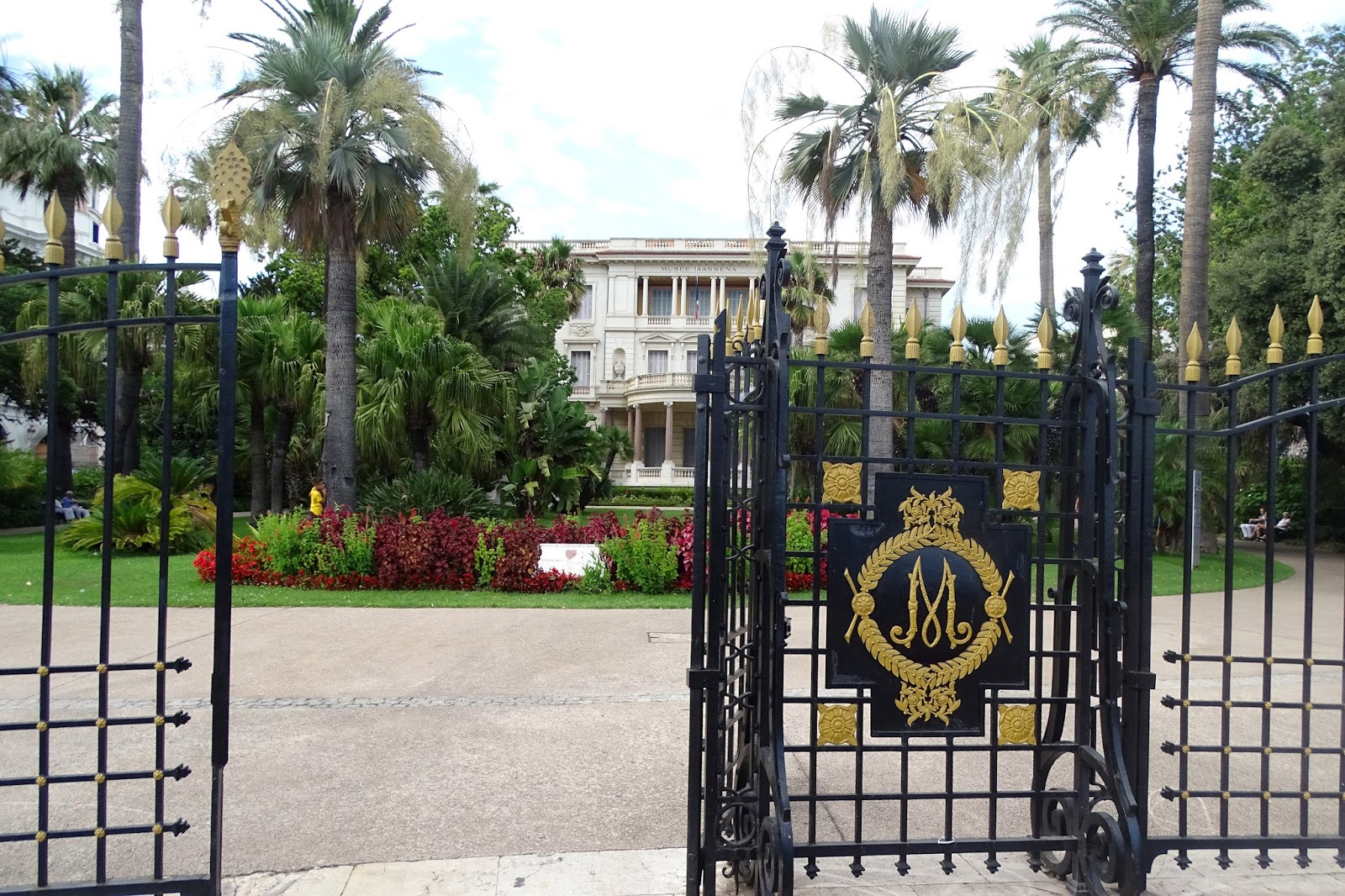
Gilded iron
gate, Musée Massena,
Nice |
In Nice we also appreciated wrought iron forged in the hearths of its
blacksmiths.
 |
|
Cathedral
of Notre Dame, Chartres |
Artistry in medieval Europe reached its apex under Church sponsorship.
The fire of Christian theology, cosmology, and empire coaxed wondrous windows
from its guilds.
 |
|
The north transept
rose of Chartres Cathedral |
 |
|
Medieval glass
kiln, Chartres |
Innovative traditions live on today at the Centre International du Vitrail in
Chartres adjacent to Our Lady's Cathedral.
 |
|
Modern
artists, International Stained Glass Center, Chartres |
To roam the streets of Paris is to revel in the mythic legacy of
Prometheus, who first stole fire from the gods. The public art and decorative
balconies catalog a full celebration of man's appetites and achievements.
 |
The
Woman in the Hat, by Lapis Andras,
outside the
Hungarian Institute, Paris
|
 |
The
Thinker, garden of the Musée Rodin
Napoleon's
Tomb in background
|
The French capital displays monuments to its prominent citizens and
collective glories. They often exalt their creators as much as their subjects.
 |
|
The
Thinker, original conception |
Sculptor Rodin initially depicted The
Thinker brooding over human suffering in The Gates of Hell, the fateful fires of Dante's Inferno in The Divine Comedy.
 |
|
The Eiffel
Tower, twilight |
Inducted fires of electricity crown the skyline of the City of Light.
 |
|
Patriotic
fervor |
Sacraments of empire are as manifest in public sculpture as in the
fiery words of the French national anthem, La
Marseilles: "Arise, children of the fatherland, the day of glory has
arrived..." The whole effect seems iconographic, calculated to sweep its
citizens to unity and achievement.
 |
|
The Cathedral
of Notre Dame, Our Lady alongside the Seine |
The fires of history have spawned monarchs and popes, revolutionaries
and invaders, saints and despots on the heart of Paris, the Île
de la Cité. Its noblest building is dedicated to The Virgin Mother.
 |
|
Interior
dome of Sainte-Chapelle |
Its loveliest place of worship, Sainte-Chapelle, arose within the
palace of King Louis IX during the Thirteenth Century. He was subsequently
canonized Saint Louis.
 |
|
Rose
window, Sainte-Chapelle |
Solar light fills stained glass windows with an interior glow. The
motifs present an innate rather than a reflected beauty.
The sun fuels the processes of civilization on Earth. It renders the
invisible visible.
In gratitude the artisans of mankind aspire to respond, transforming
dreams, experiences, and earthly elements in flaming crucibles of "I
am." They ignite the works of their hands and minds with the combustion of
Creation. They answer an invitation as irresistible as breath, to die into the
newness of what might be.