Thursday, December 12, 2019

Goldenrod and Asters


Aster and goldenrod on the quarry wall
Goldenrod and asters are companionable plants at Halibut Point, finding their way into similar niches of many types. They are easy for Park visitors to recognize in a general way, particularly when in flower. They are the yellow ones and the blue ones of late summer.


Seaside goldenrod (Solidago sempervirens) and White heath aster (Symphyotrichum ericoides)
With a little closer look more distinctions of color and form appear, especially in the case of the asters. The blues vary from purple to white, the postures from tall to prostrate. The star shapes for which they are named show subtly different configurations. The leaves of various species range from broad to needle-like. Diversity abounds.


Flax-leaved aster (Ionactis linariifolia) and Downy goldenrod (Solidago puberula
The asters are multi-colored daisies. Their central button is actually a dense cluster of tiny disc flowers capable of producing seeds. Each disc flowers is ringed by five fused petals. A row of ray flowers encircles the button. Each ray flower extends a large strap-like petal outward. Collectively they make up the showy corolla. This composite ensemble comprises a bright and business-like inflorescence that attracts pollinators, children, and florists. The composite family may be the most widespread flowering plant group in the world.

With such great distribution the composites not surprisingly present a taxonomic wonderland to botanists, who currently recognize over 32,000 different species in 1,900 genera. All of these are distinguished by the daisy grouping of disc flowers, though not all combine them with large-petaled ray flowers. In botanical language they are called the Asteraceae. Previously, and still acceptably, they were termed Compositae.
In evolutionary time the daisy principle has ramified into a great many common plants. I've come across a considerable number of species within 33 genera of Asteraceae at Halibut Point, including sunflowers, thistles, wild lettuce, and dandelions.


Aster and Grass-leaf goldenrod (Euthamia graminifolia)
You may be surprised on careful examination to notice that goldenrod flowers are built on the daisy structure. That fact places them within the Asteraceae. They are close cousins of the aster. We saw in the last posting that our local goldenrods are split among two different genera, Solidago and Euthamia.

The captions on the pictures above hint at recent complexities in classifying our familiar asters. The over-arching genus Aster no longer applies to American species. The designation 'true asters' is reserved for certain relatives with evolutionary precedence from the Old World. Anyone who wants to stay up to date with botanical conversations will have to learn how to remember and pronounce some daunting terms for our latecomers.

In the next posting we will go afield at Halibut Point to consider eleven species growing there.


Friday, December 6, 2019

Goldenrod and Science, Part 2 - Systematics

I do not know what I may appear to the world; but to myself, I seem to have been only like a boy playing on the seashore, and diverting myself now and then in finding a smoother pebble or prettier shell than ordinary, while the great ocean of truth lay all undiscovered before me.... Isaac Newton


Seaside goldenrod, Solidago sempervirens
If Isaac Newton (1643-1727) were walking on the seashore at Halibut Point, the pretty yellow flowers (above) would have stirred his mind. To reach them he would have passed similar-looking plants in various upland environments. He would have thought about their similarities and diversities.


Elliott's goldenrod, Solidago latissimifolia
By the end of Newton's life a Swedish scientist named Carl Linnaeus (1707-1778) had begun formulating the classification system that we still use to sort out our encounters with organic life. We can now refer to any living thing by a unique two-word term that names its genus (first) and species. That singular name also gives a key to the plant's relationship to all other organic groups, through an evolutionary ladder tracing kinship to the entire plant kingdom and beyond. This is the simple, universal system known as binomial nomenclature.

As a general defining principle, members of a species can reproduce with each other but not with other, though similar, organisms. Finer distinctions in the characteristics of a particular plant that do not prevent its cross-breeding with other members of its species, are called subspecies, varieties or cultivars. The subspecies designation results in a trinomial such as the Solidago latissimifolia subsp edisoniana mentioned in the previous posting. Such cases may come about when two or more population groups of a species with distinctly different appearances, that do not interbreed due to geographic isolation, have fertile offspring when brought back in contact.

Notable traits within a species may be pursued or enhanced by hybridizers. They often result in an informal descriptor being appended to the binomial, such as Solidago rugosa 'Fireworks', which is a horticultural selection. Its progeny by seed might quickly revert to a type less desirable to gardeners if allowed to pollinate with other members of its species. Purity of the strain calls for restrictive sexual management, or else single-parent propagation (cloning).

These intricacies reflect the challenges to the field of taxonomy that attempts to fit all observable life into a universal system of classification.

Solidago latissimifolia flowering branches
In nature purity is not only unknown but counter-progressive. Natural life is constantly altering due to inner (genetic) or outer (environmental) influences. Noticeable variations in appearance do not reach the point of speciation unless accompanied by, or dictated by, sufficient genetic change to prevent the plant from inter-breeding with others. Sexual incompatibility with its original group may happen gradually, such as in geographic isolation during glaciations, or more suddenly in genetic mutation.


Solidago latissimifolia flower detail
The individual flower is the showy agent of a flowering plant's self-perpetuation. It has traditionally been examined by botanists for details in parsing the essential and exclusive characteristics of a species. Sometimes very minute distinctions in flower structure must be presented in your Field Guide to identify a species. Hopefully there is also more obvious morphological evidence such as leaf characteristics at hand for identification, or habitat indications.


A goldenrod-like discovery at Halibut Point
In exploring Halibut Point Isaac Newton would have been intrigued by a plant with narrow grass-like foliage and flowers for all the world like a goldenrod.


Solidago graminifolia (?)
Until recently Field Guides have presented this plant as Solidago graminifolia, the grass-leafed goldenrod. But lo and behold, current editions have re-classified it into a new genus as Euthamia graminifolia. The re-designation was made primarily because of distinctions in the arrangements of flower heads, gland-dotted leaves, and DNA sequence data.


Euthamia graminifolia
The robust, ongoing diversification of life forms challenges the search for an all-inclusive model of classification. Theories of a perfect taxonomic system undergo continual debate with new discoveries, perspectives, and tools. It is an area of very broad and also minute debates. Recently it has generated the concept of clades, which sees a species as the smallest lineage distinguishable by a unique set of either genetic or morphological traits, but where no claim is made about reproductive isolation. Thus the fact that traditional species can be seen to interbreed sometimes, across close genetic boundaries, does not invalidate the utility of the attempted scientific organization.

In the next posting we will look to the ladder of classification to see justification for the taxonomic association of yellow goldenrods with blue asters.


Thursday, November 28, 2019

Goldenrod and Science, Part 1 - Industry

Wildflowers, weeds, economic resource?  Goldenrod plants, which comprise the genus Solidago, have attracted diverse attention from people. Opinions are in the eye of the beholder.

Scientific analysis has freed it from blame as an allergy irritant. Goldenrod depends on insects to pollinate its flowers. The flowers' pollen grains are too heavy to drift in the air toward your sinuses.

Tall goldenrod, Solidago altissima,
which can exceed six feet of height in moist areas of Halibut Point
Further examination reveals that goldenrod contains a significant amount of latex, which is produced by about 10% of flowering plant species. Latex is believed to serve as a defense against insect infestation. It is stored in cells just underneath the outer layer of each part of the goldenrod plant. You might have noticed a similar substance as the milky white fluid that bleeds from a plucked dandelion stem. Tiny particles of the natural rubber polymer polyisoprene are suspended in the latex. 1

L to R: Henry Ford, Thomas Edison, Harvey Firestone 2
A century ago three of the most inventive industrialists in America, who happened to be close friends, began searching for alternative sources to imported rubber. In part they were concerned with the nation's dependence on foreign resources during wartime. Henry Ford, Thomas Edison, and Harvey Firestone contributed $25,000 apiece In 1927 to form the Edison Botanic Research Corporation. Thomas Edison, the restless mind behind the electric light bulb, the phonograph, and the motion picture camera, holder of over 1,000 patents, launched a new pursuit at his winter home in Fort Meyers, Florida. 2

Thomas Edison standing in a field of goldenrod, 1929 3
Edison invited botanists from around the world to send plants with promising latex content for analysis. His laboratory staff ground the samples and chemically treated them to determine available rubber. They analyzed more than 17,000 plant samples. Solidago was selected as the most promising group, for its high rubber content and its quick growth performance in the United States. 4

Edison and goldenrod specimen 2
Edison finally settled on a particular species of goldenrod, Solidago elliottii. He developed a cultivar to grow over ten feet tall with an improved rubber yield. This selection was later named after him, Solidago edisoniana. 5

A sample of goldenrod rubber at Edison's laboratory 1
The photograph above shows "crude" goldenrod rubber after the polymer particles have been coagulated and separated out of the latex, which is mostly water. Below is a strip of goldenrod rubber compounded with carbon particles for strength, ready to be formed into a tire.

A rubber strip made from goldenrod 1
Harvey Firestone did produce a set of goldenrod rubber tires for Edison's 1907 Model T Ford, a cherished possession given to him by his friend, Henry Ford. 6

After Edison's death in 1931 Ford spearheaded the quest. He corresponded with George Washington Carver in 1935, the innovative plant hybridizer at Tuskegee Institute in Alabama. As their relationship deepened productively, they traveled to each other's facilities. Ford sought to develop auto body materials, paint, and engine fuels derived from farming staples. They collaborated on the goldenrod latex project. Ultimately it was supplanted by more practical processes deriving synthetic rubber from petroleum.

George Washington Carver (L) and Henry Ford, 1942 7
Ford and Carver both believed that the American farm was at the core of industry. They promoted “chemurgy,” a branch of science merging agriculture and industry with a central tenet that farms played an important part in the society and should not be lost to industrialization. 8  In 1942 Henry Ford showed his admiration for his friend and colleague by naming a new Ford Motor Company facility in Dearborn, Michigan, The George Washington Carver Nutrition Laboratory.

Sources

1. "Thomas Edison, Botanist," blog Kind ofCurious.com, November 29, 2010.

2. "Thomas Edison, The Rubber Wizard of Menlo Park?", Stern Rubber Company blog, August 20, 2015.
3.  "Thomas Edison Experimenting with Goldenrod as an Alternative Source of Rubber, Florida, 1929", TheHenryFord.org website.
4. "Thomas Edison, Chemist", American Chemistry Society website acs.org, 2019.
5. "In Search of Thomas Edison's Botanic Treasures", New York Botanical Garden Herbarium, posted in Applied Science website, October 30, 2013.
6. "Phonograph Exhibit Hints at Rubber Invention", The Orlando Sentinel, October 4, 1992.
7. Photo taken in The Carver Nutrition Laboratory, Dearborn Michigan, 1942, TheHenryFord.org website.
8. "Soybean and Weeds Sandwiches: George Washington Carver and Henry Ford at the Tuskegee Institute", The History Engine website.


Thursday, November 21, 2019

Coastal Watch, Part 2 - Shorebird Bills

In an era past, when the local newspaper was able to support a weekend magazine, feature writers explored topics about the world around us. Recently I came across these interesting observations on shorebirds in the microfilmed archives of the Gloucester Daily Times at the Sawyer Free Library.


Ralph Scott illustration from "Getting Along between the Tides"
North Shore Magazine, September 3, 1977
Coastal watchers may be curious that a variety of birds somewhat similar in appearance can coexist in the same area. Naturalist Ralph Scott called attention to subtle bill differences evolved by the long-legged shorebirds that give them specialized feeding advantages and somewhat separate interests in the narrow zone between the tide lines. I compared his fine drawings with my own photographic images of birds on the Halibut Point shores.

Least sandpipers with slim, slightly decurved bills
Least sandpipers can be found probing into narrow spaces among barnacles and seaweed, on rocky surfaces.

Greater yellowlegs with long, slightly recurved bill
Greater yellowlegs are rare at Halibut Point because of their preference for soft-bottomed habitat where they can use their long bills to advantage in searching for subterranean prey. This one was exploring the sandy low tide margin of Folly Cove.

Semipalmated plover with short, stout bill
Diminutive Semipalmated plovers search with their short, stout bills for small crustaceans on the surface of rock outcroppings.

Black-bellied plover with long, stout bill
Their larger relative the Black-bellied plover has the size and strength to probe deeper into pebbled or vegetated areas with its similarly shaped but more massive bill.

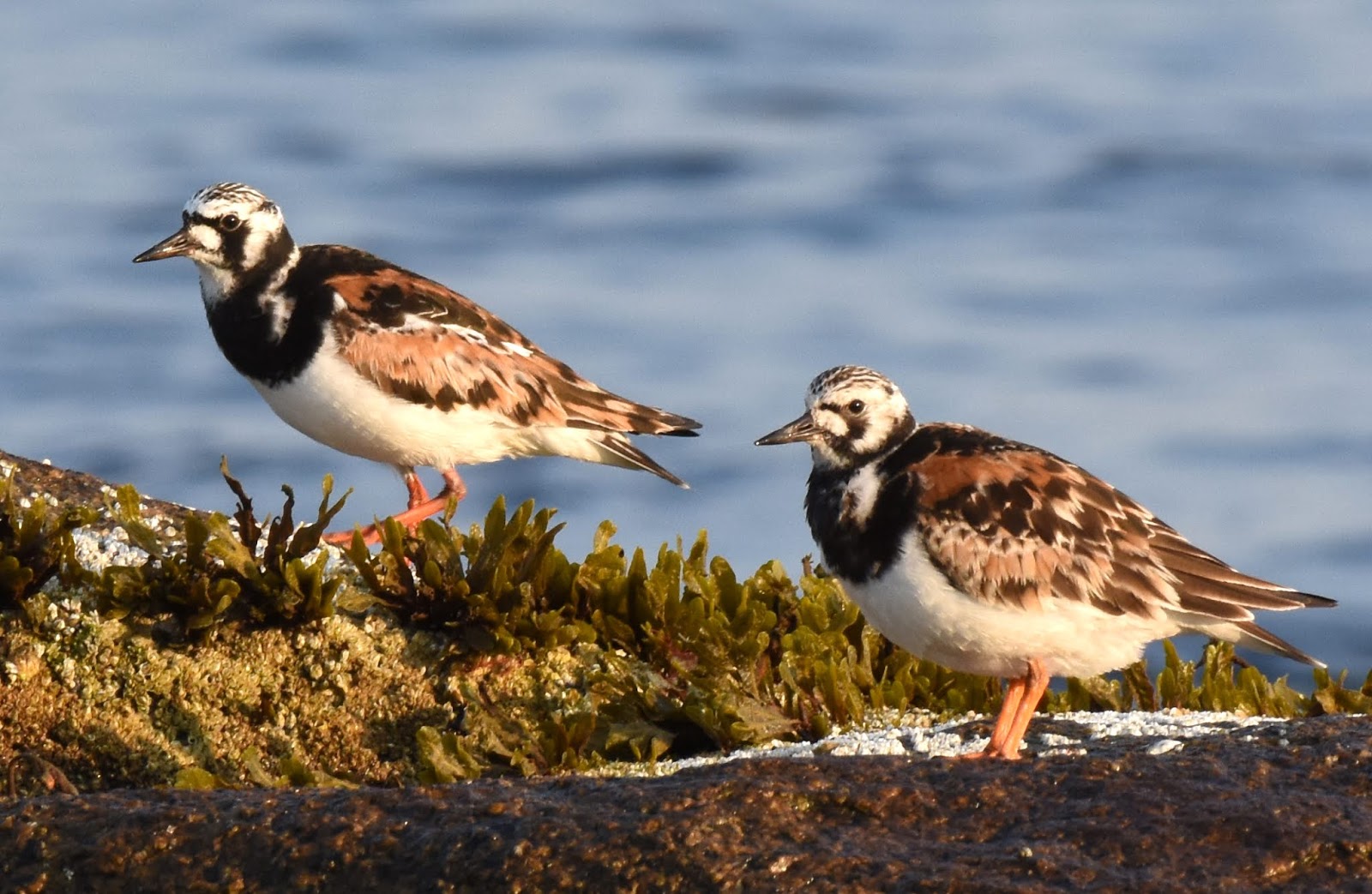
Ruddy turnstones with stout, slightly recurved bills
The flatter, recurved bills of Ruddy turnstones enhance their ability to push aside or flip over beach pebbles and debris in search of food.

Oystercatchers with long, stout, recurved bills
Oystercatchers have strong versatile bills proportionate to their chunky bodies. They use them to swish laterally, probe deeply, and hammer open small shells as well as to reach inside bivalves to snip the adductor muscles.

This great variety of bill shapes and lengths allows diverse shorebird species to congregate harmoniously and even travel in mixed flocks, each picking, probing with a distinctive feeding behavior. Their tendency to pass through Halibut Point at staggered arrival dates further reduces competition. Were the bird's feeding habits identical, the stronger, more dominant species would soon drive out the weaker species through competition. These variations in bill structure are among the many interrelated features that trace, enable, and define each species' existence in the biological world.


Thursday, November 7, 2019

Autumn Ramble 2, Fruit

Every stage and feature in the life of a plant is of course important to its wellbeing. Fruit get particular attention from the animal world, including humans, because we become partners in some species' efforts to reproduce and increase themselves. We become enlisted as seed dispersers. Sometimes we creatures collect edible seeds intent on eating them, and its only the chance scattering of remnants that helps the plant proliferate.  In other cases plants develop colorful, tasty, nourishing packages around their seeds precisely so they might be eaten, excreted, and germinated on new ground. These processes have taken root in our aesthetic  sensibilities, to the delight of photographers.


Winterberry


Porcelain berry


Green alder


Virginia rose


Cat brier


Cedar waxwing and Morrow's honeysuckle


White fir


Black chokeberry


Privet and Eastern red cedar


European spindle tree


Grape


Shagbark hickory


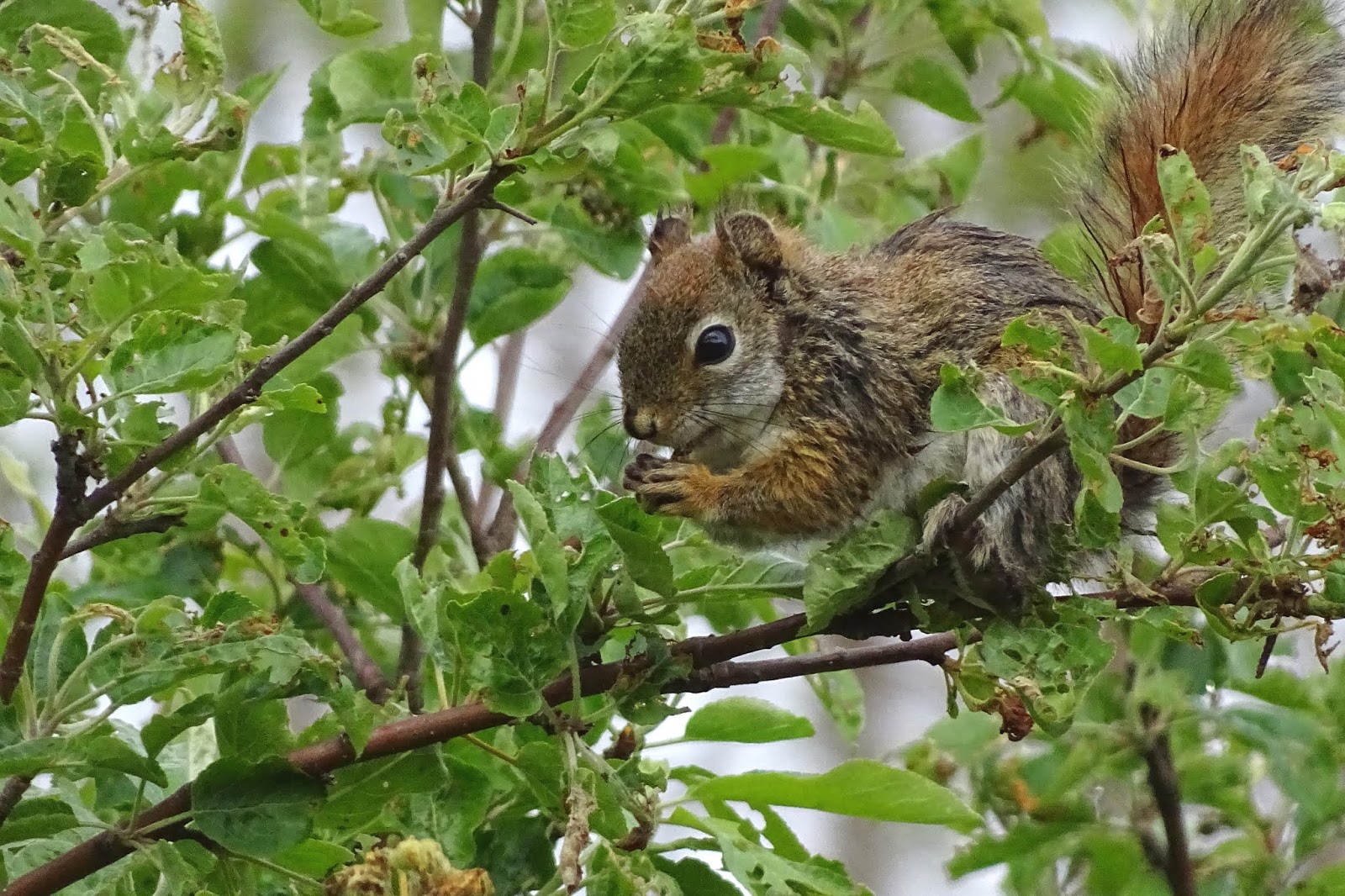
Red squirrel