Thursday, October 2, 2014

On Our Feet


White-breasted nuthatch
If you're going to understand how I'm able to walk up and down tree trunks, I want to give you my perspective on growing up a bird.

Your scientifically-minded community has a pretty good grasp on how things happen. They've organized me and most of my friends into an ornithological order called Passeriformes, which is based on the way we perch.
Take a good look at brother titmouse: three toes forward and one toe backward, all joined to our legs at the same point. That defines passerine. Our grip closes automatically when we land on a branch, and stays that way even while we're sleeping.

Tufted titmouse
But it's not just about sitting. We can cling to almost any surface, like this phoebe on the quarry wall.


Phoebe on quarry wall
It's only partly about geometry. Our toes extend into sharp claws. We need them at precarious moments.


Downy woodpecker at upside-down business
Some of my arboreal friends spend so much time in awkward positions that they've re-arranged their toes to make life easier.

Not a passerine
 In doing so the woodpeckers have earned their own order Piciformes among the science-minded: two toes forward, two rearward. That's clever on everybody's part.

Great blue heron
I was noticing the other day that the tall fellow by the quarry pond has three toes forward like me, but he's a wader not a percher. Overall his feet are nothing like mine. I could never walk on oozy ground without sinking. The scientists knew their stuff putting him in a separate order, the Ciconiiformes, which in their Latin language means 'stork-like.'

Double-crested cormorant
There's a place by the quarry where seabirds sometimes stand out of the water, which gives me a chance to satisfy my curiosity about their propeller feet. Absolutely not handy for perching, but powerful for swimming. When I checked into their standing with ornithologists I found a complication, that the cormorants may be reassigned from the order Pelecaniformes ('pelican-like', four toes webbed together) to Suliformes ('gannet-like'), which I like, because gannets visit Halibut Point and pelicans don't.

Turkey dust bath
Speaking of big feet, I was watching some turkeys at a dust bath the other day and was very impressed with their ability to scratch away the turf.

Tom turkey
Spending all day on the ground, they have three specialized toes for walking, foraging, and running like the blazes when trouble comes along. Their fourth toe, the spur with the claw, makes Old Tom fierce in a heated moment. He's in an order with fighting cocks, Galliformes, 'chicken-like' but lordly.


Circling hawk
The feet I shudder to mention belong to raptors, which refers in Latin to 'seizing by force.' Their sinister talons can snatch warm bodies like mine from the treetops. They clench with a relentless, opposable hind claw. The ornithologists have decided to be fair-minded to birds of prey, according them the order Falconiformes.

A heroic crow chasing the hawk away

When hawks come around my robust passerine kin come out in force for the safety of the neighborhood. They don't rely on their feet for this feat, but on agility and esprit. 
 
I have to be alert all the time to stay out of trouble. Really, I don't bother anybody except the bugs in the bark.


I'll show you the trick. My toes help me scramble around the branches. They're state-of-the-art in perching design. Over, under, up and down, it's all the same to us nuthatches. 

Thursday, September 25, 2014

Fields of Gold


In the final mass banquet served to our local insects, goldenrods bloom through September. The swaths and spots of gold that please our eyes provide essential energy to the insects' preparations for winter, for continuation of the species if not the individual.
The goldenrods themselves are remarkable in reserving their vigor through months of uncertain rain until this season when they have the attention of pollinators mostly to themselves. Their green parts stay fit and succulent all summer to achieve this.
All sorts of intriguing creatures fly in for the sustenance. They may at other times be carnivores or herbivores. At the moment flowers fill the bill.
People stay on reasonably good terms with honeybees whose overwintering plan accumulates honey that we share-crop.
 
When it comes to flies the benefit to us is not so clear. Nevertheless goldenrods open their stamens to all comers who join in pollination. Perhaps you agree that the flies give spark to an innocent scene.
Other encounters are freighted with deeper wariness, whether inborn or acquired through a sting from an equally defensive wasp.
Certainly hornets are temperamentally and physically equipped to hold their ground with mere humans. They sport bold markings rather than camouflage as a warning of their potency.
The delicately limbed manage to find a place among the strong. The abundance of the offering keeps peace.
At rest the fast-flying denizens of Halibut Point are available to us for curiosity and wonder.
Their improbabilities variously stimulate love and loathing. Our best management plans aspire to allowances for all. That is our rational power.
For the bugs it's basic: keep it going.
Rationality summons the alignment of our impulses with wisdom. Our sense of beauty invites us to recognize that all is one.

Friday, September 19, 2014

September Blues

Last week, on the first brisk day of the season, ocean alchemy transmuted Ipswich Bay into ultramarine. The color startles me even though it is predictable, like geese flying south. Nature reserves it for deep waters, rarely land or air. Like all colors it corresponds to certain mood phases.


Ultramarine conveys a spare dignity. George Washington adopted it for his Continental Army coat. The United States Postal Service used it on early stamps. Each syllable pair in the word connotes the unconquerable. Ultramarine. Say it slowly to yourself. 

As generously and diversely as The Pigmentist uses blue in water and sky, he restricts it modestly elsewhere. That tension makes blue many people's favorite color.
 

Cichorium intybus, chicory
Chicory flowers borrow blues from the horizon to the sky's zenith. Toward their pale center lies periwinkle, deepening through celestial blue  to azure at the tips of the petals. These tints have been available to artists since the rendering of the mineral lapis lazuli in ancient Persia. 
 
Partly because of its terrestrial rarity blue stands out noticeably in the landscape. I use it for marking flags in garden design. Blue lights in the rear view mirror invariably arrest a driver's attention.
 

Myrica pennsylvanica, bayberry
Blue suffuses the glaucous  bayberries developing now at Halibut Point. At midday the berries go white; at dusk gray. But that is the province of light rather than pigment.
 

Picea pungens, Colorado blue spruce
A spruce tree illustrates the complex relationship between blues and greens. Its shades shimmer, mingle, and disappear, calling to mind a parallel in the ancient quest to manufacture a blue mineral from copper and cobaltous oxides.  The resulting hue called caeruleus  in Latin meant, imprecisely, "dark blue, blue or blue-green." Prior to modern chemistry cerulean blue had the weakness of reverting to green in noble works of man.

Swida amomum, silky dogwood
September matures certain fruits into a pleasing range of blues. Exactly how you name them is a personal matter. Your conclusions may evolve with the ripening. For me these silky dogwood berries evoke the achievements of Egyptian blue and Chinese porcelain blue.

Viburnum dentatum, smooth arrowwood
Closer to black, viburnum berries offer Prussian blue to aesthetes as well as to birds.

Symphyotrichum novi-belgii, New York aster

As red begins to influence the blue spectrum, it produces blue-violet. The aster family exhibits a broad range of bluish colors including lavender and indigo. We name these tones most readily by referring to other flowers.
 
Blues occupy the cool portion of the spectrum, a calm between the industrious yellows of August and the pyretic reds of October. September lays summer down and extends a hand to fall. It clarifies the atmosphere and waters with gem-quality blues like aquamarine, turquoise, and sapphire. 
 
We're coasting a bit on summer bounty, not quite compelled to the compromises of autumn. Loveliness abounds with a wistful air. September blues stir the realm tenderly.


Thursday, September 11, 2014

Abuzz

Japanese knotweed, fallopia japonica
An old adversary has taken over a corner of Halibut Point. I had  rarely seen Japanese knotweed in bloom because its galloping expansions make it an unwelcome rogue in most landscapes.

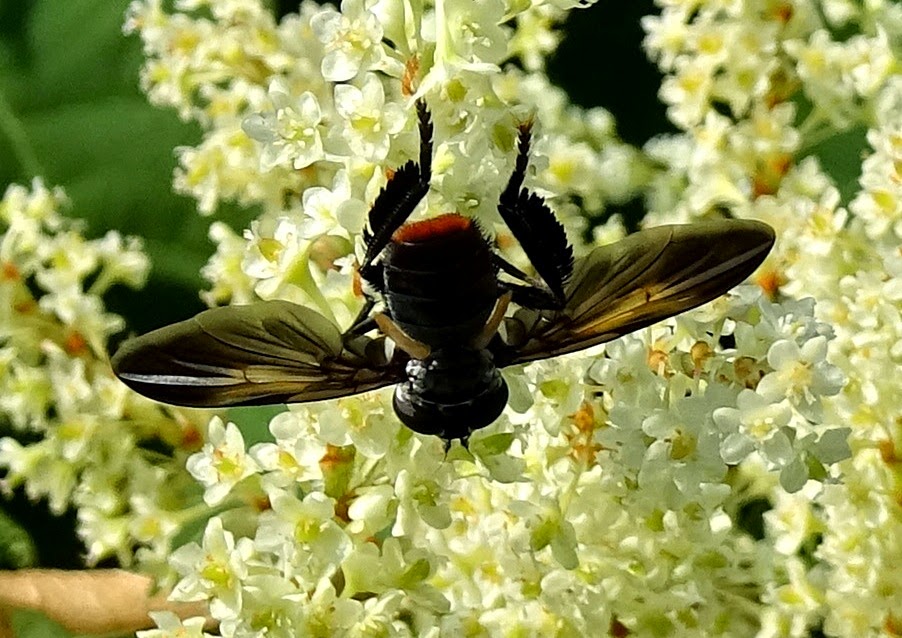
During late August Halibut Point's knotweed hedge offers a perfect salon for making acquaintance with bees, hornets and wasps. Insects with a sweet tooth congregate to the flowers appreciatively. They would doubtless applaud further expansions of the hedge.
Close-up photographs drew me into their beguiling pastures that should stagger them  with visual if not physical inebriation.  But the winged ones are all business and can still fly.

Both the plants and the creatures in the hedge salon draw nervous attention from people. I am among the majority who have not embraced them before. But these portraits from a recent morning suggest new potentials for astonishment in the natural world.


Thursday, September 4, 2014

Purple, Gold and Green

Cirsium vulgar, bull thistle
In the crescendo of late summer at Halibut Point life's energy flourishes in purple and gold, powered and mediated by green.  A thistle and bee sport the colors of the day.


Goldfinches keep their eyes out for the seeds developing within the thistle flowers.

Solanum dulcamara, bitter nightshade
Purple and gold harmonize as complementary colors. Green, secondary in our visual spectrum, is primary in the  conversion of sunlight to life.

Nuttallanthus canadensis, blue toadflax
At no other time of year are purple and gold so prominent in the landscape. Flowers of late summer wear these colors lavishly like medallions of achievement in the biosphere sweepstakes.

Scorzoneroides autumnalis, fall dandelion
Lythrum salicaria, purple loosestrife
The Treasury is full. The Creator is pleased. The colors of royalty adorn the Land. Flowers give freely to butterflies who help endow their progeny.


Helianthus divaricatus, woodland sunflower
Phytolacca americana, pokeweed
Some fruits maturing purple may be comestible only to birds, as the pokeweed; or edible to humans as well, like the grape.


Loosestrife and solidago sempervirens, seaside goldenrod
The purples and golds and greens form a banquet bouquet.