― Amit Ray, Walking the Path of Compassion
Thursday, November 9, 2017
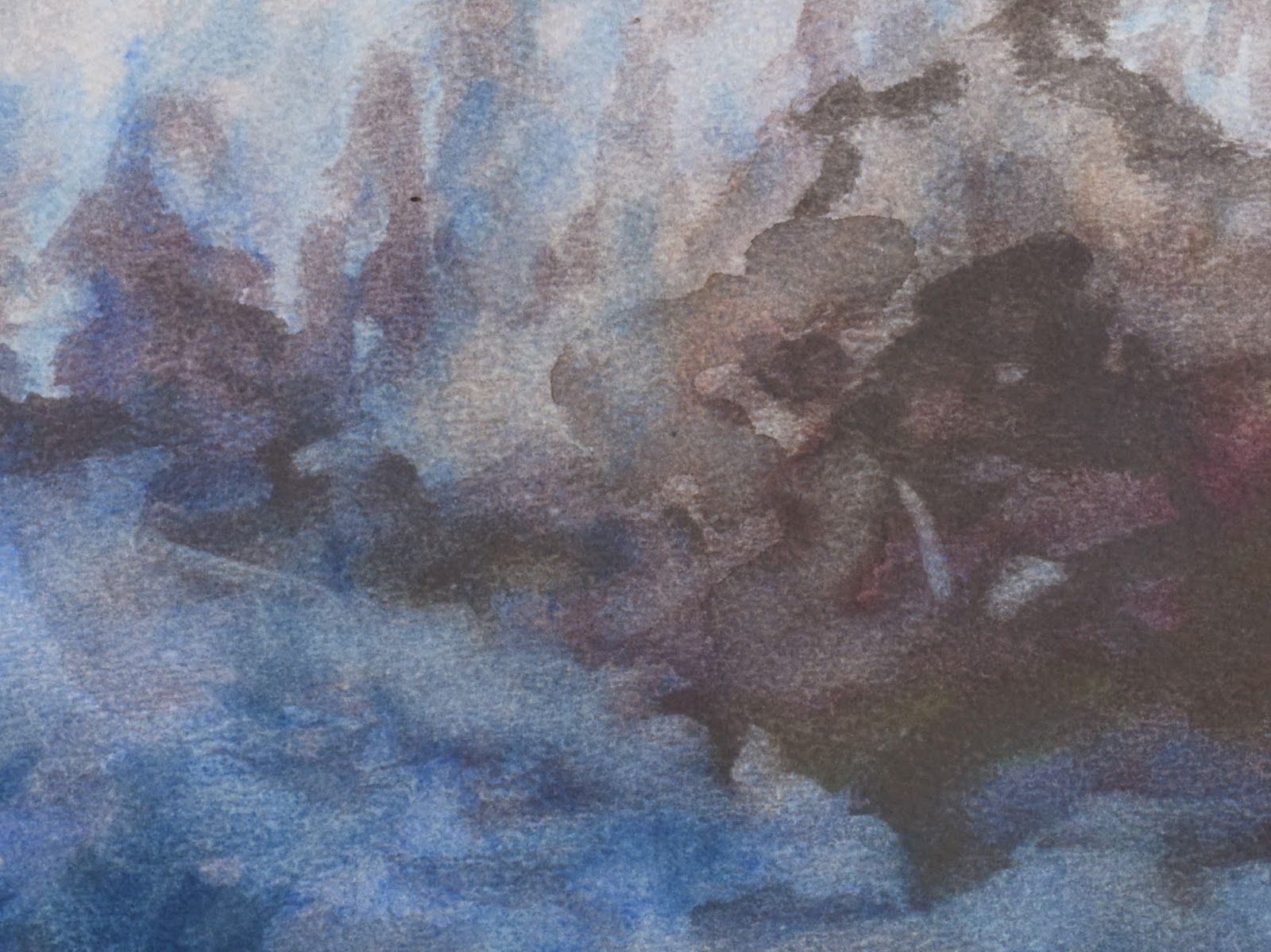
Rocks and Sky
“Beauty is the moment when time
vanishes and eternity arises.”
― Amit Ray, Walking the Path of Compassion
Thursday, November 2, 2017
Rocks and Sea
‟After the extravagant gesture
of creation in the first place, the universe has continued to deal exclusively
in extravagances... .The whole show has been on fire from the word go. I come
down to the water to cool my eyes.”
― Annie Dillard, Pilgrim at Tinker Creek
Throughout the night the sea laps at the rocks. Then the dawn fire eases over the horizon with theatrical lighting.
― Annie Dillard, Pilgrim at Tinker Creek
Throughout the night the sea laps at the rocks. Then the dawn fire eases over the horizon with theatrical lighting.
A particular morning lingers in gold.
Another lavishes colors from the palette of water and stone.
Rocks force the water into crests, dissipating energies the
sun has invested in the sea and air.
Water atomizes over the rocks in colors blended from the sun
and sky.
An opposition of natures resolves into processes of
destruction and opportunity at the intersection of rocks and sea.
Eider ducks forage in the turbulent zone.
Their life force cycles a bit of the drama back up into the
air, resplendent in creation.
The extravagance proceeds to an infinite standard of beauty.
Thursday, October 26, 2017
Shoreline Rocks
Once you get a little used to a
terrain cleansed of sense, you realize that there is amusement enough to be had
here, and that only in its emptiness can the magic crystals of beauty originate.
― Michal Ajvaz, The Golden Age
We stand on the rocks
with our separate shoreline business in the outgoing tide. The marine rocks wear
an obscuring overlay of flora and fauna as the uplands do.
― Michal Ajvaz, The Golden Age
The shoreline ingredients seem simple enough: rocks, water
and sky. The simplicity eases me away from cluttered thoughts to one version of
happiness, immersion in the natural world, a reunion with origins.
In another version of
happiness I want to reach through the photograph to make an activity of
modeling the ingredients with my hands.
Aesthetic components are well represented among the
shoreline rocks. Chaos (Χάος, undifferentiated existence)
and Cosmos (Kόσμος, the complex, orderly universe)
abound. Incalculable power lies in repose. There are reasons for it all, order
in the disarray. It is a theater of time.
A sharp and precarious
cleavage suggests the potency of change. I draw close with vigilance.
Crevices recapitulate in miniature the evolution of vast
landscapes. They undergird life's understanding of its planetary origins and
the fundamentals of its expression in art. They feature lines of teasing trails
over slopes and plateaus, possibilities and trepidations. They challenge the
random and the familiar.
I need to organize the
experience of looking at it. I put a frame around it to absorb the harmony in a
manageable scale.
The rocks exist through an endless geologic dance of form
and movement. They contain and release minerals essential to organic formulae.
They give platforms for anchorage and ambulation.
I need relief from the
dynamic geometry, the fractures and smooth-pummeled edges, the relentless grays
and browns. An incidence of life pioneers across the rocks in signature green.
At times I notice my preference for certain curves and
proportions, textures and sheens, repetitions and singularities, evidence and
mystery.
I wonder whether these
discoveries are static or eventful, reflections of compositions within my own
body and mind.
They draw me back into
the recesses of experience and forward beyond horizons.
Rocks confound the logic of degradation and beauty, of
disintegration and coherence, of irrelevance and unity, of restlessness and
harmony.
For a moment I am
hypnotized by mutual animation. Then I move on to satisfy my desires.
Rocks define the shoreline, the ceaseless inventions of the
sea.
I come and go, seeing
the rocks at different tides. Passing clouds change their appearance entirely,
as does the track of the sun. The rocks wait and I wait. Sandpipers fly in.
| Sanderlings |
In the zone between
soil and sea rocks are on full display. They form panoramas that prompt visions
and vocabulary for the aesthetic world.
Wednesday, October 18, 2017
Pathways to Brown
With thanks to Carla Mattioli and Ron Straka.
Brown is the most fascinating and least popular color. The
best way to enjoy it is to surrender into its universe of variations. Of course
being a bit recessive brown benefits from extroverts like yellow.
Why shouldn't brown be as warmly regarded as any other
color? Part of its problem is associative: brown indicates that green things,
the upside of organic life, have expired.
Associations aside, a clear-eyed look at a brown leaf may
find it more beautiful and interesting than its recent prominence in green.
When plant leaves cease their production of chlorophyll
their green coloration reduces or ends. Yellow and red pigments that have been
masked by chlorophyll's vitality may briefly come to prominence (fall
coloration), along with new, temporary purplish pigments associated with
completion of the leaf's biologic role. This purplish surge generates the
exuberant part of the autumn brown landscape. The recessive part comes not from
living tissues but from the celluloid structures within leaves and other parts
of the plant, that eventually crumble to humus.
When brown sings it receives respected names from the world
of fashion: beige, taupe, mocha, cinnamon, écru.
Many of the favored names come from animals that adopt brown protectively.
Brown is the color that plant life takes in consolidation
for solemn, enduring functions like wood. But it is also the color of decay and
mud and excrement, stuff under foot, the devolved color of humus, the reduction
of the organic rainbow. After brown comes black: darkness, the end of the life
force.
You can begin taking delight in brown by mixing any primary color
with its complement. Pick a point on this color wheel and combine it with the
hue that waits diametrically opposite on a line through the center of the
wheel. In a wet paint exercise you'd concoct one of the infinite shades of brown
as you vary the proportions of the three primaries, along with white and black.
Most of the browns you'll encounter on a walk in the vegetative
world are warm browns from the yellow-red side of the spectrum tinged with a
little blue. Blue itself is relatively rare in nature except in the sky (and
its reflection in water), so we seldom see the cooler browns deriving from
blue, except in certain flowers. Painters, decorators, and fashion designers
can use mineral-based (inorganic) blue pigments to explore the realms of brown
as the iris does. Iris, the goddess of the rainbow.
On another pathway to brown at Halibut Point, light mixes reflected
yellows and reds onto the blue surfaces of water where it is admired by people
of many hues.
In its full range the color brown adorns the diverse
vitality of life.
Thursday, October 12, 2017
The Gratified Eye
| Common Cattail |
| New England Aster |
| Orange Sulphur butterfly, Small White Aster |
Gray Hairstreak
butterfly, Showy Goldenrod
Brassy yellow pulls me into this scene, the orange spot
rivets my eye, but the muted green-blacks sustain the picture and the intricate
grays provide a field for lingering.
| Ruby Meadowhawk |
| Juniper berries (Eastern Red Cedar) and Virginia Creeper |
| Catbrier |
The catbrier's complex of hues extends through the mineral and vegetative realms. They glow brighter between the blues of sky and water in mutual amplification.
At the end of the day the terrestrial palette goes to black under a pastel salute from the sky.
Thursday, October 5, 2017
Cameo Appearances
Gifted with flight, birds move
adaptively around the world. The Great Urgency brings many species to pass
through Halibut Point during their seasonal migrations. This week I've begun to
notice brief visitors that I haven't seen here since spring or early summer.
Some of these are juveniles heading south with an inborn compass and not yet at
the full magnificence of plumage that we will enjoy when they return with mating
ambitions.
Out of this group of 'cameo appearances' the phoebe, kingfisher and oriole may actually have nested locally. If so they melted inconspicuously into the woodlands after the boisterous days of courtship and parenting. Whether a return or an emergence their presence re-animates the landscape after a quiescent few months.
|
Golden-crowned
Kinglet |
|
Belted
Kingfisher |
|
Eastern
Phoebe |
![]() |
|
Swamp
Sparrow |
|
Baltimore
Oriole |
|
Yellow-rumped
Warbler |
|
Northern
Flicker |
Subscribe to:
Posts (Atom)