| Floating Leaves |
Blueberry branch, backlit |
Lichens |
Cattails bowing out, |
Cat brier stems and
berries, |
| Floating Leaves |
Blueberry branch, backlit |
Lichens |
Cattails bowing out, |
Cat brier stems and
berries, |
| Barred Owl |
Paul took Brady home and came back for another look. He led us to the spot. By this time the nocturnal creature had settled in to sleep the day away. We were able to photograph it as minor intruders on the bird's schedule. We left it to its slumber.
Some time later a commotion rose in the forest to try the owl's equanimity.
Cooper's Hawk |
Its presence was discovered by a competitor at the top of the local hunting order, a Cooper's Hawk. The Lord of the Day chattered with outrage.
The frustrated hawk sounded for all the world like a scolding squirrel, which is one of its favorite prey. Perhaps it had learned the alarm call from its victims. Then too, many taciturn species scream warnings and terror at mortal predicaments. Even rabbits and deer.
The Lord of the Night secured its ready talons to the branch and dozed unperturbed. Had the Lord of the Day achieved a territorial purpose or simply vented? It flew off to survey raptorial prospects in the brightening realm.
Apple, Malus sp.
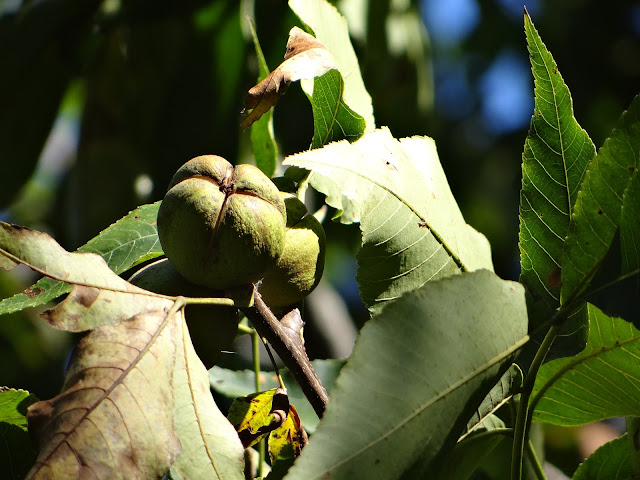
Shagbark hickory, Carya ovata |
Maturing hickory nuts cause a good deal of
excitement among the squirrels and chipmunks who scramble through the branches
harvesting nuts even before they fall to the ground where turkeys, foxes and
rabbits look for them. Any nuts overlooked by the harvesters from their winter
food caches have a chance of sprouting to generate new trees at some distance
from the parent.
Virginia
Creeper, Parthenocissus quinquefolia |
Virginia Creeper and Catbrier often clamber
together over woody or rocky supports to reach for sunlight. These vines simultaneously
produce dark blue fruit. The combination of Virginia Creeper berries on red
stems against the decorous Catbrier leaves makes a pretty picture, above.
Poison
Ivy, Rhus radicans |
Besides scrambling and rooting
opportunistically, Poison Ivy spreads by producing attractive berries to induce
birds to ingest and disperse its seeds to improbable distant locations.
Virginia
Rose, Rosa virginiana |
Creeping, turf-building native roses utilize similar
methods to Poison Ivy for colonizing the moors of Halibut Point, but have devised
different techniques for self-defense.
Little
Bluestem, Schizachyrium scoparium |
Botanically, a grain of grass is also a
kind of fruit. The fruit wall is very thin and is fused to the seed coat, so
that almost all of the edible grain is actually a seed, making an economical bargain
for dispersal by wind or bird.
Carrion-flower,
Smilax herbacea |
There is a seldom-noticed short, thornless, herbaceous
(non-woody, dies back annually to the ground) version of Cat Brier at Halibut
Point that fruits in remarkable clusters, which is how you're most likely to
find the plant among its robust menacing cousin with almost identical leaves.
It gets its name from a carrion smell given off by the flowers that appeals to
certain insect pollinators.
European
Spindle-tree, Euonymus europaeus |
Before the fruiting capsules of Spindle-trees
open so spectacularly, they closely resemble the model that defines this
otherwise diverse genus represented on Halibut Point by imported Oriental species
Burning Bush (E. alatus), Evergreen
Wintercreeper (E. japonicus), and the
native, less colorful Eastern Spindle-tree (E.
atropurpureus). The plant gets its name from its hard fine-grained wood
that lent itself to carving spindles.
Bittersweet,
Celastrus scandens |
The showy fruit of Bittersweet
(Celastrus scandens)
bear a close resemblance to berries of the above-listed Euonymus, as both are members of the family Celastraceae. This plant of Oriental origins probably gets its name
from opposing characteristics as a rampant invader and a prized ornamental.
Easter
Red Cedar, Juniperus virginiana |
On an interesting botanical note, Juniper berries are
neither true berries nor actually a fruit. Conifers (gymnosperms) in ancient
times evolved a primitive method of reproduction without flowering parts
(angiosperms), which have enclosed ovaries that generate fruit to surround
their seeds. Juniper seeds, like other conifers, are located on the surface of
the cones. They are nevertheless very successful at multiplying their progeny
into the thin-soiled meadows and moors of Halibut Point, often as a
transitional tree to woodlands reclaiming agricultural or industrial areas.
Our eyes are placed side by side. They move easily across horizons. Their view expands to left and right with the slightest turn of the head.
The vertical realm asks more effort, concentration, intentionality. We check our balance before tipping our heads up or down. Does something await our vision?
Looking at pictures in scroll formats simulates worldly discoveries of what lies above or below our primary focus.
In many ways October reveals the culmination of growth and the re-purposing of the life force.
![]() |
| Leaf miner trail, grape leaf |
| Porcelain Berries |
![]() |
Mallard drake, quarry wall |
Cardinal view |
![]() |
Transformation |
Cat Brier |
Chalcid
Wasp, one-eighth inch |
Spider notch |
![]() |
Flower Fly, aster |
![]() |
Ring-billed Gull |
![]() |
Misty morning |
In late summer a succession of asters gradually supplants goldenrod as the sustaining flower for the nectar seekers of Halibut Point.
Leonard's Skipper butterfly, aster, goldenrod |
In October the diversity of flying insects diminishes. Various bees make up an increasing proportion of the insects still foraging on flowers.
Honey Bee, Apis mellifera |
While initially they stay partial to goldenrod, as those flowers fade asters become the main attraction. The bees will have food for an additional few weeks.
Sweat Bee, Lasioglossum sp. |
Since most of them are quite a bit smaller than Honey Bees, their elegant details of attire are harder to appreciate.
Metallic Green Sweat Bee, Halictidae sp. |
And it's not as easy to get a good look when they're also constantly on the move investigating nectar sources.
Eastern Bumble Bee, Bombus impatiens |
On the other hand plump, amiable Bumble Bees forage languidly usual. Just to look at them you might think summer will never end...
Thread-waisted Wasp, Ammophila nigricans |
...but diversely configured wasps that earlier enlivened the landscape have become scarce...
Colorful Foliage Ground Beetle, Lebia viridis |
... fewer beetles visit the upper layers of the meadow....
Mason Wasp, Euodynerus foraminatus |
...and other foragers search for the last bits of sustenance.
Striped Sweat Bee, Agapostemon sp. |
Shorter days and the lower angle of the sun are bringing a sense of closure to the season. I suspect that conservative flowers time the opening of their pollen and nectar reservoirs with sunshine and warmth, extending the pageantry into the middle hours of a fall day.
Apple tree bearing well, August 2020 |
A look up into the branches of apple trees on Halibut Point this summer confirmed that most had recovered well from the recent devastation by Gypsy Moth caterpillars.
Defoliation, July 2018 |
Two years ago, at the peak of the local infestation, fruit were sparse and could not be sustained after the trees lost their initial set of leaves. In 2019 we held our breath for concern that successive years of defoliation would kill the trees outright. "Miraculously" the pests did not return. The trees began recovering strength but produced no apples. Some of the damaged oak trees did not fare so well.
Gypsy Moth caterpillars at work, June 2018 |
Spring drought conditions in recent years had limited the effectiveness
of a soil borne fungus imported from Japan as a targeted pesticide, Entomophaga
maimaiga, which has helped keep Gypsy Moth populations in check since the
last large outbreaks of the 1980s.
Nashville Warbler in apple blossoms, May 2020 |
Favorable spring rains the last two years have proliferated the fungus, leading to Gypsy Moth suppression and bountiful flower production by the apple trees.
Northern Parula warbler, May 2020 |
Migrating warblers glean other species of caterpillars feeding on the apple tree's unfurling leaves and blossoms.
Eastern Yellowjacket, Vespula maculifrons |
Toward the end of this summer sugary, mature apples dropped to the ground where they have given late-season sustenance to a variety of insects.
Common Green Bottle Fly, Lucilia sericata |
The banquet for insects has been helped by Park mowing tractors that chop and mash the litter into apple sauce.
Parasitic Wasp, Disogmus sp., one-eighth inch long |
Tiny wasps, hovering and flitting like fruit flies, form little clouds over the mash. A congregation of winged creatures take advantage of the bounty.
American Hover Fly, Eupeodes americanus |
Bald-faced Hornet, Dolichovespula maculata |
An ant, a Root Maggot Fly, and two Spotted-winged Vinegar Flies |